Recently I was invited to an environmental awareness and training program for high school teachers in my district, organised by OISCA south India. After a brief talk with the delegates of OISCA, I was asked to talk for a few minutes about the differences that I found in Japanese high schools and Indian high schools. Since its an impromptu and brief speech I decided to speak only about reforms we need here.The current school system in India is archaic and dates back to the colonial period. Three significant differences struck my mind. I am not arguing these three attributes are peculiar to Japan. In fact most developed countries already implemented these.
1. Extra-Curricular Activities
2. Curriculum and Career Guidance
3. Admission to Universities and Colleges.
Like always 2012 Olympics also didn't bring many medals to India. Ever wondered whats the basic problem with our sports? The most significant argument is that it has never been encouraged at the school level, with the rare exception of some expensive private schools. Of course there are national sports meets conducted for every sport. But over the years it has become just a custom. In this highly competitive system of ours, every parent wants their child to score more than their peers. A number of tuition and coaching centers have flourished in the cities and small towns of our country, where most students would attend coaching classes after the school.
In contrast most of the Japanese high school students would be spending a couple of hours after the school in their assigned 'club'. High school clubs, are student based school organisations,functioning with myriads of tasks, varying on specific purpose of each respective club. Each club focuses on an activity like Music, Dance, Football, Tennis, Badminton, Athletics etc and practice it everyday. Since the child gets an opportunity to develop a particular talent from a very young age he may excel in it when he reaches his adulthood. The school also allocates a substantial amount of its expenditure in providing good facilities for these clubs to function.
I think India should do the same. Because of the competition no one cares about these extra-curricular activities. And it also requires huge investments. So the government should provide the incentives and the capital to set up 'clubs' in every school.
Currently India produces over 700,000 engineers a year, nearly 10 times that of US. And not surprisingly only 30% are employable. Even graduates from A graded college are finding it difficult to find job. The Average salary of a B.tech graduate in my state(Kerala) is equal to that of a manual laborer(at the initial stage) because of too much supply of B.tech graduates. So what really lead to this inundation of engineers.
This distortion is not confined to just IITs. Colleges of Delhi University are the premier centers for Science, Arts and Commerce courses. Every year these colleges announce a cut-off list. For example St. Stephen's college, one of the prestigious colleges in the country announced a cut off of 96.75% for its Economics (Hons.) course and 95.66 for Physics(Hons.) course, meaning only students who obtained the respective score or above in their 12th grade public exam would be considered for admission. Here also, the college lays emphasis only on the marks. They do not consider any other talent or achievement of the applicant. So naturally students will dedicate their entire time in scoring high in exams and neglect other things.
I think its a need of the hour to change this outdated system of admission. The universities should consider all the attributes of the applicant and not just his scores. Only this way the high school students of our nation will have the incentives for all round development.
1. Extra-Curricular Activities
2. Curriculum and Career Guidance
3. Admission to Universities and Colleges.
Extra-Curricular Activities
Like always 2012 Olympics also didn't bring many medals to India. Ever wondered whats the basic problem with our sports? The most significant argument is that it has never been encouraged at the school level, with the rare exception of some expensive private schools. Of course there are national sports meets conducted for every sport. But over the years it has become just a custom. In this highly competitive system of ours, every parent wants their child to score more than their peers. A number of tuition and coaching centers have flourished in the cities and small towns of our country, where most students would attend coaching classes after the school.
In contrast most of the Japanese high school students would be spending a couple of hours after the school in their assigned 'club'. High school clubs, are student based school organisations,functioning with myriads of tasks, varying on specific purpose of each respective club. Each club focuses on an activity like Music, Dance, Football, Tennis, Badminton, Athletics etc and practice it everyday. Since the child gets an opportunity to develop a particular talent from a very young age he may excel in it when he reaches his adulthood. The school also allocates a substantial amount of its expenditure in providing good facilities for these clubs to function.
I think India should do the same. Because of the competition no one cares about these extra-curricular activities. And it also requires huge investments. So the government should provide the incentives and the capital to set up 'clubs' in every school.
Curriculum and Career Guidance
Currently India produces over 700,000 engineers a year, nearly 10 times that of US. And not surprisingly only 30% are employable. Even graduates from A graded college are finding it difficult to find job. The Average salary of a B.tech graduate in my state(Kerala) is equal to that of a manual laborer(at the initial stage) because of too much supply of B.tech graduates. So what really lead to this inundation of engineers.
20 years ago before the NEP reforms, when India was still growing in the so called 'Hindu rate of growth', the upper class families consisted of mostly engineers and doctors. people often looked up on engineers and doctors and IAS or IPS officers with veneration. So most middle class parents aspired their children becoming an engineer or doctor or a civil servant, hoping that all their difficulty will end. and in the early 90s the IT revolution started in India. IT Companies started hiring in large numbers and everyone wanted to be an engineer, if not a software engineer. The demand for engineering seats kept on rising even as the demand for engineers in the economy consolidated. Hundreds of engineering colleges,mostly private, sprang up across the country. Most of them with poor quality, producing unemployable graduates.
If you look into the situation more carefully, the underlying cause of this phenomenon was the lack of information or guidance about various job opportunities for the students. Things have changed a lot in the last two decades in India. There are a lot of highly paid employment opportunities in the horizon. In fact as there was an over supply of engineers, presently India has a shortage of quality graduates in many other fields.
I think schools should educate its students about the different career options available for them. Moreover curriculum should be more flexible at high school. At the moment a student can choose only a set of science, commerce or humanities subjects. They should have the freedom to choose subjects from any of these streams, and construct their own set of subjects.
Admission to Universities and Colleges
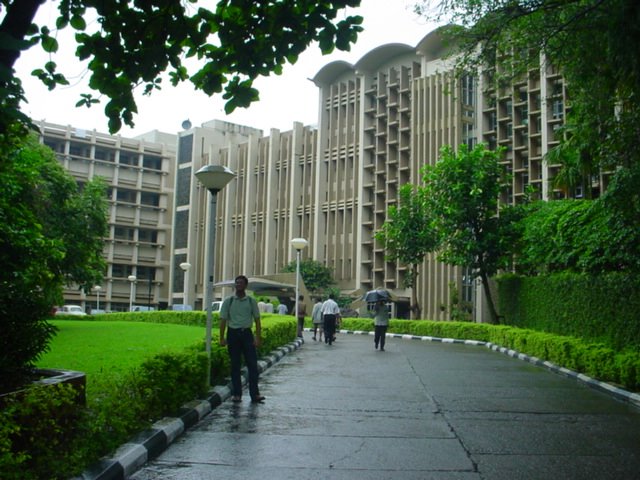 |
| IIT Bombay Campus |
Last year more than half a million students took the highly competitive IIT-JEE(Joint Entrance Exam) pursuing their dreams of studying in an IIT(Indian Institute of Technology). Only less than 2% could make it. Where as MIT(Massachusetts Institute of Technology) accepted around 10% of the 18,000 applications it received. Indian Institute of Technology was a vision conceived by Jawaharlal Nehru after his visit of MIT. He wanted world class engineers and scientists to build a strong nation. Over the years many of its alumni have turned out to be reputed personalities in various spheres.
IIT currently conducts an entrance exam(IIT-JEE) with maths, chemistry and physics questions. Due to the magnitude of competition most IIT aspirants spend their time going to tuition classes, after and before school and even on holidays. The only relevant criteria for admission to country's premier technological institution is your IIT-JEE score. So students aspiring 'big' would not have any incentives to develop skills other than academics, like communication skills, sports and cultural talents, language development and general knowledge. This would result in students turning 'machines' who can solve complex scientific and mathematics question but lack practical and professional skills.
This distortion is not confined to just IITs. Colleges of Delhi University are the premier centers for Science, Arts and Commerce courses. Every year these colleges announce a cut-off list. For example St. Stephen's college, one of the prestigious colleges in the country announced a cut off of 96.75% for its Economics (Hons.) course and 95.66 for Physics(Hons.) course, meaning only students who obtained the respective score or above in their 12th grade public exam would be considered for admission. Here also, the college lays emphasis only on the marks. They do not consider any other talent or achievement of the applicant. So naturally students will dedicate their entire time in scoring high in exams and neglect other things.
I think its a need of the hour to change this outdated system of admission. The universities should consider all the attributes of the applicant and not just his scores. Only this way the high school students of our nation will have the incentives for all round development.


